If you are wondering about the process digital marketing experts use to explain how Google Ads works, it begins with businesses bidding on relevant keywords to display advertisements to people who are frequently searching for their products or services. Google Ads can help businesses reach potential customers at the perfect time and drive targeted traffic, leads, and sales.
What Is Google Ads?
Google Ads is Google’s online advertising platform that enables businesses to display paid advertisements on Google Search and other Google properties. Rather than waiting for organic rankings, businesses can run paid campaigns to appear when users search for relevant products, services, or information.
For instance, a company offering web design services can target searches related to web design and advertise to users who are already looking for those services.
The platform supports several advertising formats, including:
- Search ads
- Display ads
- Shopping ads
- Video ads
- App campaigns
- Performance Max campaigns
Each campaign type serves a different marketing purpose, so businesses must choose the option that aligns with their goals and target audience.
How Does Google Ads Work?
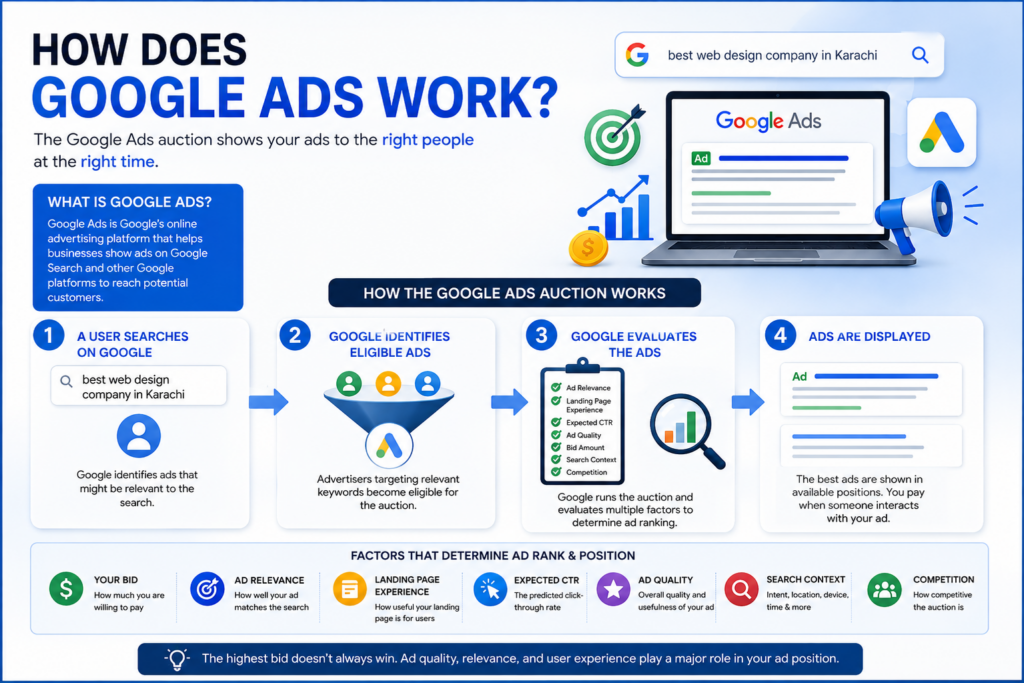
Understanding how Google Ads works requires looking at the auction system behind every search advertisement.
When someone searches on Google, an automated ad auction determines which eligible advertisements can appear. Advertisers select keywords, create ads, choose targeting settings, and set bids or budgets.
Google then evaluates multiple factors before deciding which ads appear and in what sequence.
These factors can include:
- Your bid
- Ad relevance
- Landing page experience
- Expected click-through rate
- Ad quality
- Search context
- Competition
This means that the advertiser with the highest bid does not automatically receive the top position. Ad quality and relevance can also have a major effect on presence.
How the Google Ads Auction Works
The Google Ads auction happens whenever a user performs a search that might trigger advertisements.
The basic process looks like this:
1. A User Searches on Google
A potential customer enters a search query, such as:
“best web design company in Karachi”
Google identifies advertisements that might be relevant to that search.
2. Google Identifies Eligible Ads
Advertisers targeting relevant keywords might become eligible to take part in the auction.
Google considers factors such as:
- Keyword targeting
- Location
- Device
- Search intent
- Ad relevance
- Campaign settings
3. Google Evaluates the Ads
Google examines the eligible advertisements, applying its auction system. Advertisers don’t just pay for a position; the quality and relevance of their advertisements are also considered.
4. Ads Are Displayed
The ads that meet Google’s requirements can be visible in the available advertising positions.
The advertiser generally pays when someone interacts with the advertisement, relying on the campaign and bidding model.
What Determines Google Ads Cost?
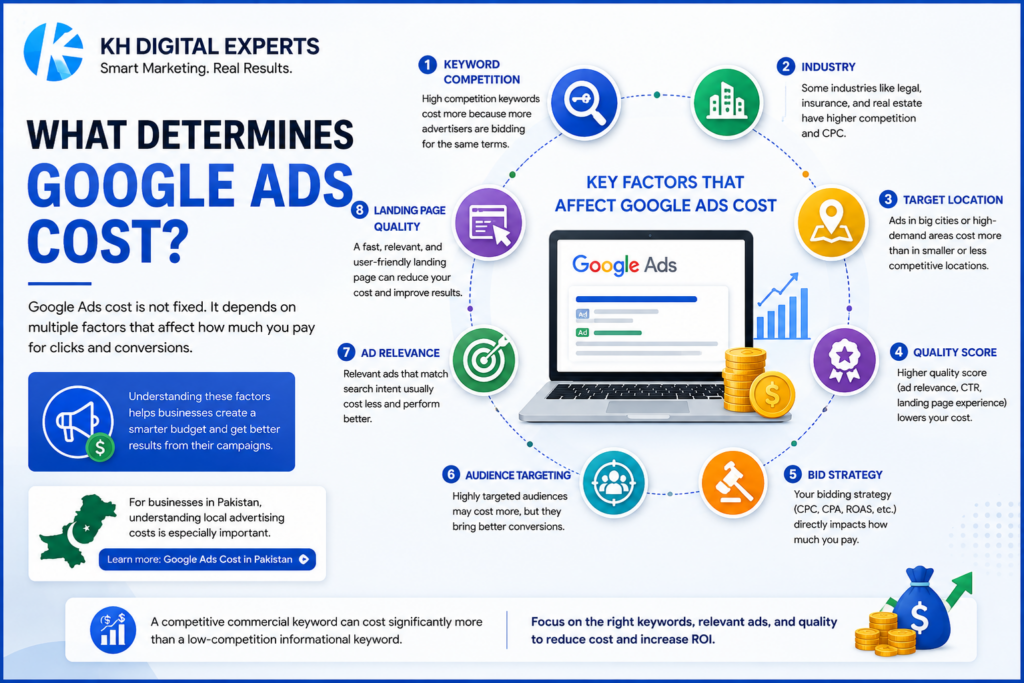
Google Ads does not have one fixed price. The amount businesses spend can vary relying on industry, keywords, competition, location, targeting, and campaign aims and objectives.
For businesses operating in Pakistan, understanding local advertising costs is specifically crucial. You can also review our in-depth guide on Google Ads cost in Pakistan to understand the larger factors that influence campaign expenses.
Some important factors impacting cost include:
- Keyword competition
- Industry
- Target location
- Quality Score
- Bid strategy
- Audience targeting
- Ad relevance
- Landing page quality
A competitive commercial keyword can cost significantly more than a low-competition informational keyword.
What Are Google Ads Keywords?
Keywords tell Google when your advertisement might be relevant to a user’s search.
For example, a digital marketing company may target keywords like:
- PPC services
- Google Ads management
- digital marketing services
- SEO services
- web design services
However, simply adding keywords is not enough. Businesses need to understand search intent and make sure that their advertisements and landing pages satisfy what users are actually searching for.
Why Search Intent Matters in Google Ads
Search intent is one of the most significant considerations when building PPC campaigns.
Consider these two searches:
“what is PPC?”
and
“PPC services in Karachi”
The first search is primarily informational, while the second indicates stronger commercial intent.
A business selling PPC services might find the second query more valuable, as the searcher may already be looking for a service provider.
Understanding intent can help businesses lower wasted clicks and emphasize their budget on searches that are more likely to generate meaningful conversions.
Google Ads Bidding Strategies
Google provides different bidding strategies based on campaign objectives.
Common strategies include:
Cost Per Click (CPC)
With CPC bidding, advertisers focus on receiving clicks to their website while managing how much they are willing to pay.
Cost Per Acquisition (CPA)
CPA-focused bidding aims to generate conversions at a target acquisition cost.
Maximize Conversions
This strategy allows Google to automatically optimize bids with the aim of generating as many conversions as possible within the available budget.
Target ROAS
Target Return on Ad Spend can be valuable for businesses that want to optimize campaigns around the revenue generated from advertising.
Selecting the right strategy relies on your campaign data, conversion tracking, budget, and business objectives.
Importance of Ad Quality and Relevance
A successful Google Ads campaign is not just about increasing bids.
Your advertisements must closely match the user’s search intent. The landing page must also provide the information or solution promised in the advertisement.
For example, if your ad promotes PPC management services but sends users to a generic homepage, visitors might leave without taking action.
A better approach is to send users to a dedicated and relevant landing page. Businesses interested in professional paid advertising can learn more about PPC services and how a structured campaign can support lead generation.
Google Ads and Local Businesses
Google Ads can be especially useful for businesses targeting customers in specific cities.
A local company can target locations, languages, devices, audiences, and relevant search terms to reach potential customers within its service area.
For example, someone searching for a ppc expert in Karachi may already have strong commercial intent. A relevant advertisement and well-optimized landing page can help a business compete for that search.
Similarly, businesses targeting Lahore can create campaigns around searches such as ppc expert in Lahore, provided the service is genuinely available in that market.
Local PPC campaigns can work alongside organic local search strategies. Businesses can also improve their local presence through Google Business Profile optimization to strengthen visibility across Google’s local ecosystem.
Google Ads Conversion Tracking
Conversion tracking helps businesses understand what happens after someone clicks an advertisement.
Depending on the business, conversions might include:
- Contact form submissions
- Phone calls
- Purchases
- Quote requests
- Account registrations
- Appointment bookings
- WhatsApp inquiries
Without trusted conversion tracking, it becomes difficult to understand which campaigns, keywords, and advertisements are actually producing business outcomes.
Tracking conversions enables advertisers to make better decisions about budgets and campaign optimization
Common Google Ads Mistakes to Avoid
Many businesses waste advertising budgets because of poor campaign setup or weak optimization.
Common mistakes include:
- Targeting irrelevant keywords
- Ignoring negative keywords
- Using broad targeting without proper controls
- Sending every visitor to the homepage
- Writing generic advertisements
- Failing to track conversions
- Ignoring mobile users
- Not testing different ad variations
- Setting unrealistic expectations
- Failing to review campaign performance
Avoiding these problems can make your advertising budget more efficient and improve the quality of your traffic.
How to Create a Successful Google Ads Campaign
A strong campaign should start with clear business objectives.
Follow these steps:
Step 1: Define Your Goal
Decide whether you want leads, sales, phone calls, website traffic, or another measurable result.
Step 2: Research Keywords
Identify keywords that align with your products or services and understand the intent behind them
Step 3: Organize Campaigns
Group related keywords and advertisements into logical campaigns and ad groups.
Step 4: Write Relevant Ads
Create advertisements that clearly communicate the value of your offer and match the user’s search.
Step 5: Build Relevant Landing Pages
Send visitors to pages that directly address their search and give a proper next step.
Step 6: Set Up Conversion Tracking
Monitor meaningful actions so you can measure campaign performance.
Step 7: Monitor and Optimize
Review search terms, clicks, conversions, costs, and other performance data on a daily basis.
FAQs - How Google Ads Works
1. How does Google Ads work for businesses?
Google Ads works through an auction system where businesses bid on relevant keywords. Google considers factors such as bid, ad relevance, quality, and search context to determine which ads appear.
2. How much does Google Ads cost?
Google Ads costs vary depending on keywords, competition, industry, location, targeting, and bidding strategy. Businesses can set their own advertising budgets and adjust them based on campaign performance.
3. What are the main types of Google Ads campaigns?
The main Google Ads campaign types include Search, Display, Shopping, Video, App, and Performance Max campaigns. Each type is designed for different advertising and conversion goals.
4. How can I improve my Google Ads campaign performance?
ou can improve performance by targeting relevant keywords, writing compelling ads, optimizing landing pages, using negative keywords, tracking conversions, and regularly reviewing campaign data..
5. Is Google Ads worth it for small businesses?
Yes, Google Ads can be valuable for small businesses because it allows them to target specific keywords, locations, audiences, and budgets. With proper targeting and conversion tracking, paid campaigns can generate qualified leads and sale
Final Thoughts
Google Ads can give businesses a fast way to reach people who are actively searching for their products and services. However, successful PPC advertising requires more than simply creating an advertisement and setting a budget.
The best results come from relevant keywords, strong ad copy, effective targeting, optimized landing pages, accurate conversion tracking, and continuous campaign improvement.
When you understand how does Google Ads work, you can make more informed decisions about your advertising budget and build campaigns focused on measurable business results.